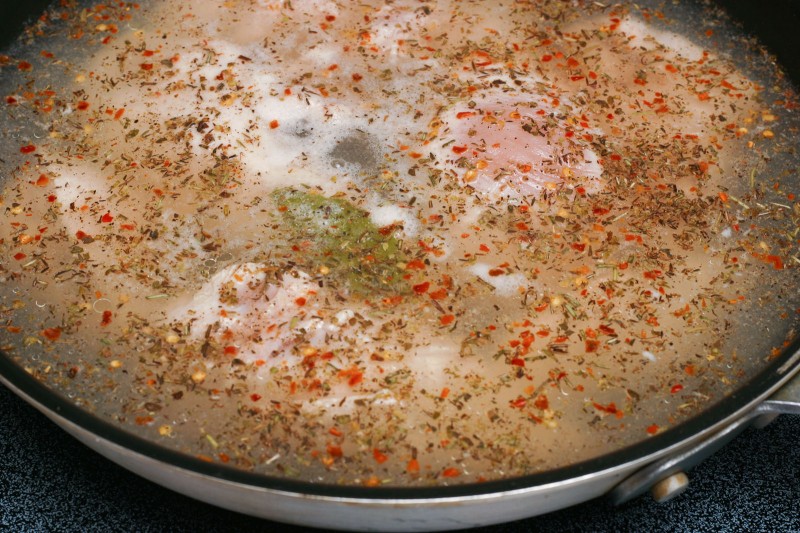
Poached chicken is one of the most versatile things you can have sitting around in the fridge. Mix with a sauce and toss it in a sandwich. Add some dressing and place it on a salad. Throw it with some pasta and your done!
Chicken Caesar Salad, Chicken quesadillas, Vietnamese chicken salad… Done, Done and Done!
I love making a large batch of poached chicken in the beginning of the week. It gives me tons of dinner and lunch options through out the week. The basic recipe for poaching chicken is below, but you can easily spice it up. Add rosemary, a bay leaf and oregano for Mediterranean chicken. Add some Chile powder and Tabasco for some spicy fun. Kick up the flavor by cooking the breast in chicken broth instead of water. You get the idea. Just remember to always add salt to the water. Also, instead of boneless chicken breast you can also use split, bone-in, skin on breasts… or if you are feeling bold, chicken thighs. The bone-in cuts might need an extra 5 minutes of simmering.
POACHED CHICKEN
Ingredients:
- Chicken (Boneless chicken breast, split chicken breast or chicken thighs)
- Salt
- Liquid (Water, broth, and/or wine)
- Flavorings (rosemary, bay leaf, thyme, oregano, lemon zest, ginger, garlic, celery, onions, carrots… etc)
Directions:
- Place chicken in pan.
- Add enough of the liquid to cover the chicken.
- Add salt and flavorings.
- Bring the liquid to a boil and then reduce to a simmer.
- Simmer for two minutes, longer for bone-in pieces (~5 additional minutes)
- Remove pan from heat and cover.
- Let sit for 30 minutes.
- Place chicken in container, cover with liquid and refrigerate.
Pingback: How To Season Chicken Breast Ternak Puyuh | Ternak Puyuh
Thanks so much for this easy cooking method. I needed a way to have flavorful chicken when I couldn’t find bone in chicken breast at the grocery. This saved me and is very moist. I am making chicken pot pie. Will use this method for many more dishes. Easy easy and so delicious. Thanks from Texas on a cold winter night. :)
Just to thoroughly confuse the issue, there is always the simple, error-proof, delicious, moist, option of “Bake-In” bags. They yield perfect chicken every single time. I use the boxed Italian Dressing mixes as an instant flavoring and you are eating awesome chicken in 30 minutes that tastes tender and moist like poached but with minimal effort. You can also cook sliced potatoes, carrots, etc in the bag.
Just googled cooked chicken and here it is. Cool. Thank you.
Trying it with salt, some mexican spices and Tecate beer for enchiladas. I’ll post a follow up!
This works perfectly if you follow the instructions. The chicken is tender and it picks up the herbal flavors well. Great option for chicken used for chicken salad.
Pingback: King Ranch Chicken Casserole – Two Versions | KITCHENOLOGY: The Study of All Things Kitchen!
Pingback: How to cook Chicken! | InstructaZine.Com!
I tried this once, brought to boil then straight off heat for 30 mins like u say. Did I put too much water in the pan? Is it important to only just cover the breasts by an inch? otherwise there is too much residual heat left in the water and it overcook?
Forgot to say my point! The chicken was dry and stringy!
Mark, it sounds like you may have boiled it too hard before letting it simmer. The amount of liquid really shouldn’t matter. In fact, the liquid, which is now a fairly light stock, is as useful as the meat. I happened upon this post while looking to remind myself of how long to poach a chicken breast, but I’ve not tried the simmer and sit method. I’m going to, but with extra veggies and liquid so I can use it for chicken and dumplings.
Pingback: My Filipino Favorite: Absolute Travel Addict’s Pancit Bihon | The Absolute Travel Addict
Pingback: Mexicasserole | Mom Mom's Apron
Pingback: My Filipino Favorite: Absolute Travel Addict’s Pancit Bihon - Absolute Travel Addict : Absolute Travel Addict
Your step 8 says to store in “liquid” – do you mean the liquid you cooked it in? Or do you mean use a fresh liquid? Thanks!
I would store the chicken in the liquid that it was cooked in. Plain water would suck out all the flavour.
I know this post is several years old now but I stumbled on this today. I tried it out with frozen chicken and made it into a salad. My daughter said it was the best chicken ever and when my husband asked how I cooked it… he was surprised. The look of poached chicken is unappealing but definitely taste worthy!
I want to poach my chicken before I grill it. How long should I grill after its been poached.
DANGER: Simmer two minutes, let sit for 30. Salmonella warning… not saying you will get sick, but you may. Simmer 10 minutes.
Since you are bring the water and chicken up to a simmer, not adding the chicken to boiling water, the chicken stays above 160 for along. Holding it in the hot water also cooks the chicken through. The goal is to cook the chicken through without exposing it to high temperatures which would toughen it up.
I’m really into it, thanks for this great stuff!
Thank you so much for this easy and tasty recipe – I needed to start cooking for my 10 month year old and with no prior experience this was a cinch and she loved it!
We have been using this a ton lately to cook for our 16 month old. It makes it really easy to cook up a big batch of chicken for her lunches.
can I poach a whole chicken – without separating the parts? i’m brining it but I feel like being lazy and just poaching it whole.
Yes, absolutely! I use a traditional Chinese method that you will find if you search for Hainanese Chicken. There are several variations on this recipe. I have been doing it for several years and perfected my own method:
Take a large 8 litre saucepan. Fill with –
– one standard 750ml bottle of Chinese cooking wine (you can use a dry white wine instead but will need to add some salt)
– about 4.5 litres of water
– grated thumb sized piece of ginger
– 6 cloves of garlic, crushed and chopped
– bring to the boil, turn off.
– carefully submerge a whole free range chicken (1.4 – 1.6 kg), put on the lid. Leave for 1 hour.
– after the hour, turn heat back on low for 30 minutes.
– Turn off heat. Very carefully lift chicken out and place in a large high sided dish.
Amazingly tender and delicious!
Really important: Turn heat back on under the stock, boil, reduce by a half. When cool, strain through muslin and store. You now have the best chicken stock ever!
Pingback: chicken breasts that aren't dry
This is the only thing I can cook that comes out OK. I throw a few carrots in with a bullion cube. I make some Uncle Ben’s rice because that is the only brand that I can cook without it coming out like sludge. Then I boil down the liquid so it is like gravy. It tastes pretty good. I tried it with some kind of a beef roast and used a beef bullion cube but it turned out like shoe leather. So I guess it only works for chicken breast.
Kyle, A beef roast is better cooked in a crock pot. Slice some onions. Cut the onion in half, then slice, put them in the bottom, Put a little salt and pepper on the onions, now you have to options…you can brown your roast in a pan on the stove in some butter or oil for about five minutes per side, or you can just throw it in the crock pot. Browning the roast gives you better juices at the end of cooking. Either way, before you put it in the crock pot, season the roast with salt, pepper, and if you have it, garlic and onion powder. (If you don’t have those go Family Dollar and buy some, they are cheap). Then cook on High for three hours. After three hours, add potatoes you have scrubbed (you can peel or not) and carrots (that you should peel) and cook another two hours. Take the roast and vegetables out. Mix two tablespoons of cornstarch with a little bit of water in a small bowl. Add it to the juices in the crock pot and stir until it thickens. You will have gravy. Enjoy your dinner.
Pingback: Aarti Paarti’s Baked Samosas | Wanderlust for Food
Hi there! I think your receipe looks extremely practical, I am looking to have more options at breakfast instead of just eggs all the time. I think poached chicken will make a nice change!
can you poach chicken from frozen or do you have to thaw first?
Can someone help me?
abdolutly frozen is fine! Poached chicken is very forgiving sometimes i even more than simmer lol. If its frozen your going to need to keep it simmering for 10 minutes before the heat comes off
What about high altitude cooking? I am just learning to cook and learned very early on that there is a big difference between 7,000 feet and 200 feet!
I live at 10,000′ and I’ve found that boiling eggs is a much larger challenge than baking cakes! For chicken, I bring to a boil for one minute, simmer covered for 15-20 minutes (more time for bone in) on low, then turn off burner (leave pot in place) and let sit for 15-20 more minutes. It works, it’s not tough, and best of all you are sure it’s really cooked. And then make the perfect boiled egg and tell me how to do it!
This worked wonderfully for me!
Thanks alot.
This is a very dangerous recipe. Simmering chicken for 2 min is not long enough.
The initial cooking time of 2 minutes is just to get the chicken started, the actual finishing of the chicken happens once the pan is off heat, covered and let to rest for an additional 30 minutes. There is a ton of residual heat leftover that will be more than enough to cook the chicken (however thick) through.
Its long enough if you know how to cook
2 minutes at a simmer and 30 resting is plenty. If the chicken breast is white when you slice/dice/shred it, it’s fine. I have used this method for years, and it works beautifully. It’s like boiling an egg. Get it to boiling, take it off the heat and cover for 11-13 minutes (depending on how you like your yolk) and it will be perfectly boiled every time.
I appreciate your concern for food safety, but the water in the pan holds plenty of heat to cook the chicken, and you get a much more even result this way without drying out the outer parts to get the inner parts cooked. Water is an excellent conductor of heat :)
I have never had an issue with poached chicken using this method, but if I did, I would know when I dices it or shredded it, at which point I would cook it a bit more.
I tend to over-poach my chicken and end up with the chewy stringy version. I basically just boil the heck out of it, lol. Anyway, I’m going to try this version for sure. However, no matter how I cook chicken or any other meat, I always check it with a digital thermometer. They aren’t expensive, a must have kitchen gadget, IMO. I worked in a restaurant and food safety is ingrained into my brain.
Pingback: Only Here for the Food » Blog Archive » The Cooking Chronicles: Chicken for Lunch
i was wondering about doing the chicken breast in orange juice. Do u think it would work?
honestly i dont see that being a good idea. I think the chicken would take on a weird and overly sweet flavor
3/4 parts vodka and 1/4 water works a treat very tasty.
Help me out here…am not a cook normally. When poaching chicken like this, is that sufficient to “cook” it or is more cooking (ie. baking, pan fry, etc) required? Thx!
That will cook it. While sitting in the recently boiled water it will slowly cook, and not over cook it (which will make it more like leather). Remember no one is born a cook. Trial+Error=Experience
Well, it’s very moist, but not very flavorful. I use this method to pre cook-chicken for pot-pies and casseroles. I normally use leftover roast chicken for that, but my family tends to devour most of a roast chicken in one setting. I always need another breast or two. It’s fine to use for sandwiches (chicken salad or sliced chicken) or in casseroles. If you are planning to use a recipe that calls for whole chicken breasts, I would not use this method. I would certainly not use it for a stand-alone chicken breast. You are better off roasting, BBQing, or baking it.
I love this method for when chicken breasts are on sale. I poach up a ton of them, shred them, and freeze them for later use.
I don’t cook with salt at all so I wonder why you emphasize using salt?
I don’t use salt either, I used poultry seasoning, garlic powder, onion powder, and herbs. Came out GREAT! And I also add veggies, like a halved onion, carrots and celery and cook a while for great stock. Save in small containers and freeze. After frozen, release from containers and save in zip top bag. Great to have on hand in 1/2 cup and 1 cup sizes!
Try low-salt soy sauce in the water. Gives it a hint of salt.
Salt is a flavor enhancer. It is not necessary, and most people get way too much, especially through processed foods. However, it is tasty :) Also, it can perk up a dish. All people need at least a little salt in their diet. If you are not eating any garbage food, and unless your M.D. has prohibited salt, a pinch or two is not a problem.
My family eats very few processed or take-out foods. Therefore, I salt to taste. I find that if I use enough “good” seasonings (herbs, spices, pepper, etc.) I don’t need as much salt. Still, it is still something i use, especially in cooking water. Very little salt is absorbed when the salt is in the water cooking pastas or meats.
BTW, I have found that canned “foods” like Spaghettios (which I LOVE) that are labeled “preservative free” have at least 1/2 of your reccomended maximum daily sodium intake. OK for an occasional treat, but don’t let the labeling fool you. A serving of vegetables is great, but not if it gives your kids enough sodium for a day or two.
I can’t speak for the author but, in addition to what others have mentioned about flavor, in boiling water it raises the boiling point so you actually get hotter boiling water. With pastas I’m given to understand that they cook more quickly and evenly with salted water so you don’t get mushy outside and crunchy inside. That could be one reason to use salted poaching liquid. Good question!
I think the hold time will depend on how well the pot retains heat. Aluminum probably cools off fastest, if anyone still uses aluminum. Heavy stainless will hold heat a lot longer.
Very good point, vessels do matter.
I use glass pans, they are very old and look like something out of the 60’s. They take about 10 mins to bring the water to the boil when on a high heat, but they retain the heat immensely well!
My preference is to brine the chicken the night before so it doesn’t dry out, with the overwhelming heat from the pans.
Pingback: aartipaarti» Blog Archive » Aarti Paarti Ep. 30: Baked Samosas
Another note to add: Make sure you keep the liquid and freeze as homemade chicken broth. I like to add more veggies to the poaching liquid so that the broth is a little richer when it’s done. I sometimes boil the liquid after I take the chicken out, adding the veggies then. Works well.
Boiling the poaching liquid will kill any bacteria if it’s been sitting off the heat for more than 1 hour. This will also reduce the amount of water to concentrate those yummy flavours in the pot!
Pingback: Chipotle Lime Chicken Salad Wraps with Potatoes and Avocado and Mexican Red Rice
actually, if this thread is still alive, I, too, wonder if you store the now-cooked chicken in the water in which it was cooked.
also, how long, theoretically, would they last in the fridge?
thanks.
Thanks for this. I used this twice last spring, once bone-in and once boneless. I couldn’t remember how to do it, and your link is the first one that came up when I searched for “how to poach a chicken breast” in Google; I recognized it as the same one that I used last time.
This is the same page/method I used last time and it was perfect, for those who are nervous about the time/temp, this definitely cooks the breast all the way through. If you’re nervous, when it’s done, cut it in half, and you’ll see there is no pink.
As a side note: Bone in for me worked better at about 4 minutes total simmer, then the 30 minute standing time.
Thanks for reporting back Julie! I like using bone-in because I think it gives the chicken a little more flavor.
Hi – jus wanted to check before I make this that the liquid you place in container before putting in fridge is the same liquid you used for poaching? Thanks!
How MUCH salt?
Good question. The is no fixed amount since you are going to be using a different amount of liquid depending on how much chicken you have and the shape of the pot. I would say a good ratio would be 1/2 tsp per quart.
how come poaching only takes a few minutes while boiling can take up to an hour?
I firmly believe that boiling should be reserved for pasta, tea and coffee. Only. Other foods are destroyed, both nutritionally and taste-wise, by boiling. The only time I boil a chicken is when I use the picked-off carcass to make stock.
The cooking time is not really 2 minutes. It’s 2 minutes at a simmer and 30 minutes (covered) in the hot water. Trust me, it works every time.
I am of Scottish extraction, and I recall horrible meals of boiled whatever that robbed the ingredients of both flavor and nutrients.
Thank you!
Pingback: Recipe: Vietnamese Chicken Salad
I found your method of poaching through google a few months ago and I now use it pretty regularly…works great! Thank you!
Another detail; According to the Prentice Hall Dictionary of Culinary Arts, Boiling is (obviously) 212F, simmering is 185F-205F, and Poaching is 160F-180F.
Hi, everyone! I’m a little nervous about this . . . seems like two minutes is not very long! But I will try it! I guess I have an instant read thermometer and I can alway check the thickest part for i think 160.
Letting the chicken sit in the hot water for 15-30 minutes is what cooks the chicken. It brings the chicken to a high enough temperature to kill all the bacteria, but it doesn’t heat up the chicken enough to over cook it. Anything great than 150-160 will kill all the bacteria.
Correction. For poaching you do NOT simmer. There are three different kind of fully submerged liquid cooking: poaching, simmering and boiling, and they all require different temperatures. To say that poaching is the same as simmering is the same as saying that simmering is the same as boiling. So, a simmer is where the bubbles are small and gentle right? And a boil is where the bubbles are large and rolling. A poach is less than even a simmer. A poach is where tiny bubbles are forming on the surface of the pan, but are not large enough to rise to the surface. This will render a much more tender chicken breast. Also, don’t bring the water to a boil or a simmer, just gently up to a poach.
I tried this. Cut one of the boneless breasts after about 25 minutes and it seemed pink so I let it sit in the liquid 5 more minutes. Parts of it seemed tough when I diced it to use in a pasta dish. Other parts seemed nice and tender. Did I overcook it? How do you compensate for the variation on thickness in a breast so it all is cooked properly?
You are technically correct. However, if you are tending to multiple children while poaching chicken, simmering for 2 minutes and covering it off the heat for 30 is close enough. It’s not really poaching, but it works fine :)
That’s so funny. I was just browsing around to make sure I was poaching my chicken right, and you were the second google link that came up. Hi Luke.
Yea, I may have been playing it way to safe letting it sit for 30 minutes. I would definitely check way before then. Thanks for the advice!
i followed the directions to a t – fearing that the breasts would be overcooked, i stopped letting sit after 20 minutes instead of 30 but they were still a bit dry. I would experiment until you get it right. maybe let it sit for 10, 15 minutes, check to see if it’s done…instead of letting sit for the full 30 minutes. everything else was great, thanks
Thanks for this clearcut, simple recipe! I’m doing 3 breasts now thanks to you!
Pingback: BBQ Chicken Sandwich
Pingback: Recipe: BBQ Chicken Sandwich